
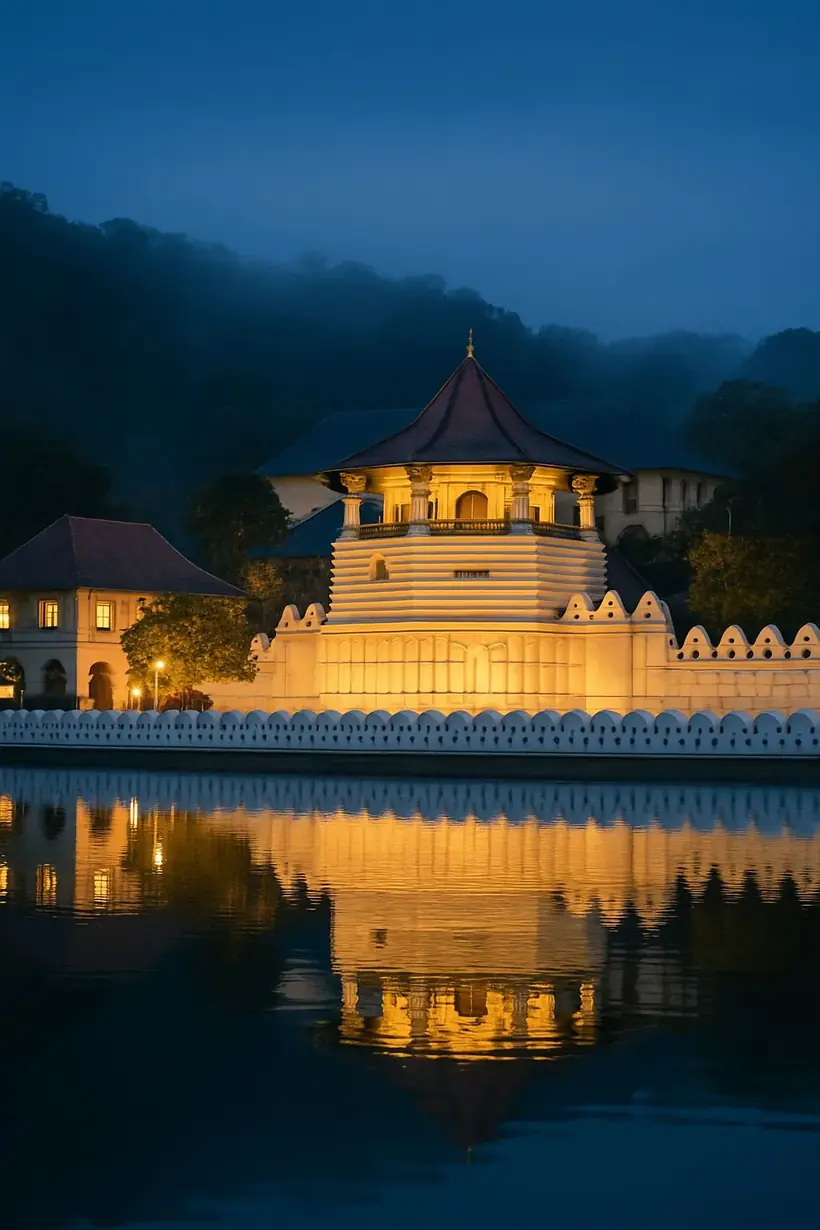
What is the Temple of the Tooth in Kandy?
Sri Dalada Maligawa stands in the old royal palace complex beside Kandy Lake. It houses a tooth relic of the Buddha, kept in a golden casket in an inner chamber; the relic itself is never on show. For centuries, whoever held the relic was seen as the rightful ruler, which is why the shrine sits beside the palace.
The temple is part of the Sacred City of Kandy World Heritage Site. Many visitors are pilgrims dressed in white and carrying lotus and jasmine, so you are stepping into a place of daily worship.
How do I get to the Temple of the Tooth?
The temple is in the centre of Kandy, about 15–20 minutes’ walk from the railway station and the main bus stands. In town, PickMe or Uber tuk-tuks give a fixed price.
From Colombo, the train to Kandy takes about 2.5–3 hours; reserve a seat if you can. Buses and cars take about 3–4 hours, depending on traffic. From Ella, the hill country train reaches Kandy in roughly 6–7 hours.
What is there to see at the Temple of the Tooth?
Allow time to sit as well as walk. The complex is much larger than the main shrine.
- The evening puja, when drummers play and the doors of the relic chamber open.
- The octagonal Pattirippuwa, best seen from the lake side.
- The carved entrance, moonstone and painted ceilings of the older shrine.
- The museum with the preserved body of Raja, the tusker who carried the casket in the Perahera for decades.
- The Audience Hall and the royal palace buildings around the temple.
When is the best time to visit the Temple of the Tooth?
Any time of year works, and January to April brings the most settled weather in Kandy. In July the hills above Kandy are often dry, even while the south-west coast is wet.
The big event is the Esala Perahera, Kandy’s great procession of dancers, drummers and elephants, held around August on dates set by the lunar calendar. The town fills up, so book well ahead. Full moon poya days are also very busy.
How much does it cost to visit the Temple of the Tooth?
Foreign visitors may need a ticket, and fees change, so check before you go. Shoes are left at a counter outside, where a small donation is usual.
- Expect a security check at the entrance, and keep bags small.
- Never photograph people praying, and keep photos discreet.
What should I wear to the Temple of the Tooth?
Cover your shoulders and knees; a sarong or scarf in your bag solves it. Shoes and hats come off at the entrance, and socks are fine on the stone floors.
White or light clothes are what many local worshippers wear, and they are a respectful choice. Do not pose with your back to a Buddha image, and keep any Buddha tattoos covered.
Temple of the Sacred Tooth Relic: quick answers
Can you see the tooth relic in Kandy?
No. The relic is kept in a golden casket in the inner chamber and is not shown to visitors. During puja the chamber doors open and you can see the casket.
When are the puja times at the Temple of the Tooth?
Pujas are held several times a day, and the morning and evening ones are the most atmospheric. Times can change, so check at the temple or with your guesthouse.
How long do you need at the Temple of the Tooth?
Allow 1–3 hours. An hour covers the main shrine; add more for a puja, the museums and a walk around Kandy Lake.
Can non-Buddhists visit the Temple of the Tooth?
Yes. Visitors of all faiths are welcome, and a puja is one of the best ways to understand Sri Lankan Buddhism. Dress modestly and move quietly.