
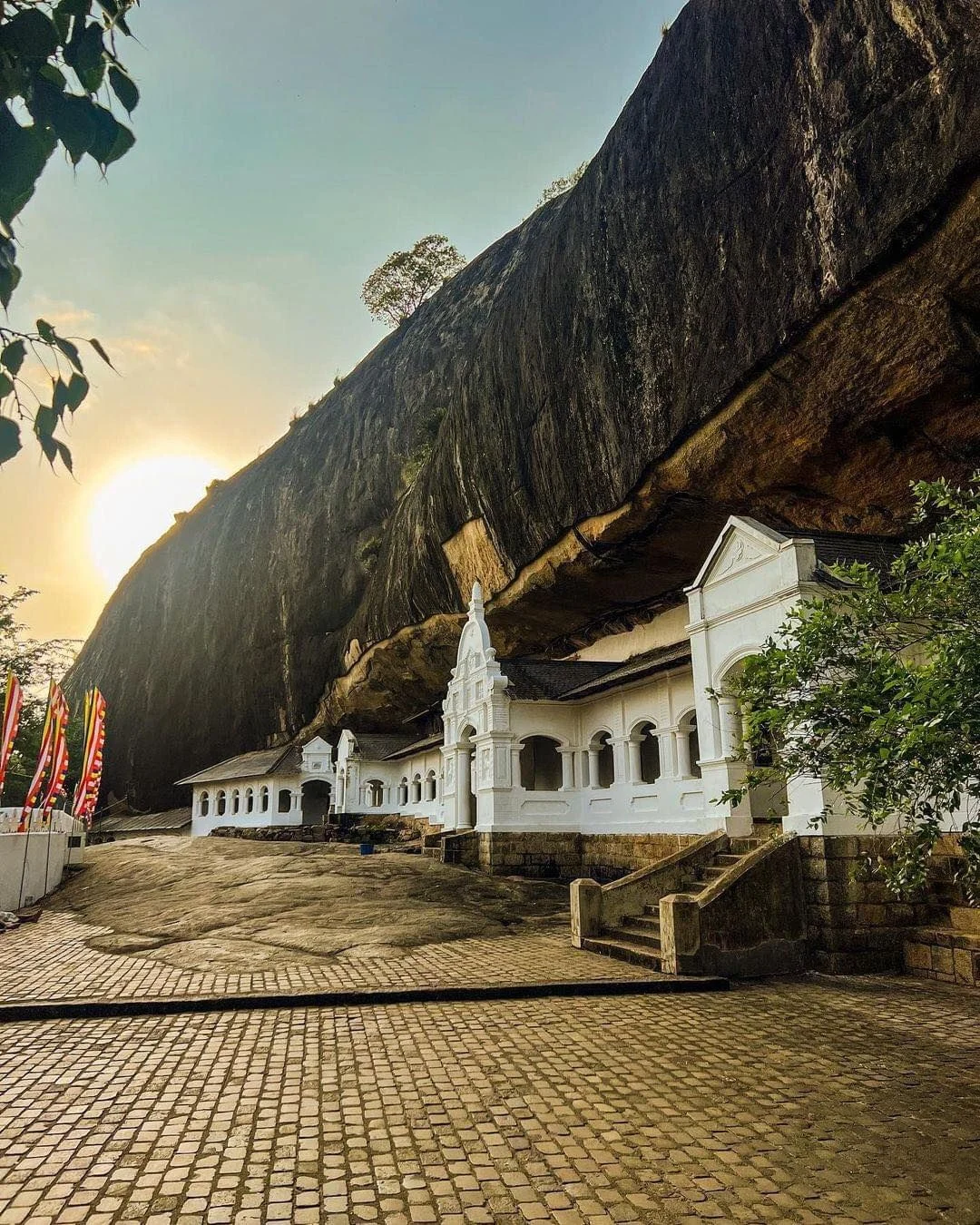
What is Dambulla Cave Temple?
Also called the Golden Temple of Dambulla, it is a cave monastery that has been a place of worship for more than 2,000 years. Tradition says King Valagamba sheltered here in the 1st century BC and later turned the caves into a temple in thanks.
Across the five caves there are more than 150 Buddha images, and painted murals cover the walls and the sloping rock ceilings. The largest cave is the most striking, but each has its own character.
How do I get to Dambulla Cave Temple?
The temple is on the edge of Dambulla town, a major road junction in the cultural triangle, beside the main Kandy road. Buses from Colombo take about 4 hours and from Kandy about 2–2.5 hours; ask to be dropped at the cave temple.
From Sigiriya it is about 30–40 minutes by bus or tuk-tuk, and many people pair the two in a day. There is no railway station in Dambulla.
What can I see at Dambulla Cave Temple?
Go slowly, because the caves are dim and your eyes need time to adjust. Each cave rewards a few quiet minutes.
- The long reclining Buddha in the first cave, carved from the rock.
- The largest cave, with dozens of statues and a pot catching water that drips from the rock, said never to run dry.
- Ceiling murals that follow the curve of the rock overhead.
- The view from the terrace over the plains, with Sigiriya on the horizon on clear days.
- The Srilor audio story, to play when you arrive; the first chapter is free.
When is the best time to visit Dambulla Cave Temple?
January to April is the best window, with dry, clear days. The cultural triangle is hot and mostly dry all year, so heat matters more than rain, though October and November can bring afternoon showers.
Go early in the morning, when the rock is cooler and the caves are quieter. Poya days are busy with pilgrims, which is moving to see but means queues at the caves.
How much does Dambulla Cave Temple cost?
Foreign visitors may need a ticket, and fees change, so check before you go. Ask where tickets are sold before you start the climb, so you do not have to walk back down.
- Cover shoulders and knees; a sarong or scarf solves it.
- Shoes and hats come off near the caves; leave shoes at the stand for a small donation.
- Wear socks, as the rock gets hot.
- Keep food out of sight; monkeys on the path will grab it.
- Never pose with your back to a Buddha, and follow the photography signs.
How hard is the climb to Dambulla Cave Temple?
It is a short but steep walk up rock steps and paths, about 15–20 minutes at an easy pace. Go slowly in the heat and take water.
The rock gets very hot by midday, and you walk the last part in socks or bare feet, so morning is kinder. There is shade at the caves and on the terrace to cool off.
Dambulla Cave Temple: quick answers
How many caves are there at Dambulla?
Five main caves, holding more than 150 Buddha images and walls of painted murals.
How long do you need at Dambulla Cave Temple?
Allow 1–3 hours, including the climb, the five caves and the view. An hour is enough for a quick visit.
Can I visit Dambulla and Sigiriya in one day?
Yes. They are about 30–40 minutes apart, so climb Sigiriya early and visit the caves later, or the other way round.
What should I wear to Dambulla Cave Temple?
Cover your shoulders and knees, and bring socks for the hot ground once your shoes are off. Hats come off too.